m4b, mp3, m4a, aac and flac, along with .audiobook and .zab packages. Either a single file, or an entire folder of chapter tracks that arrives as one book with a chapter list of its own. Importing happens straight from the Files app, with no computer anywhere in it.
Apple Books on the iPhone offers no way at all to import an M4B on the device itself. The file will open in Files, where it plays as loose audio, but nothing files it into a library, remembers where you got to or lists its chapters. What iCloud syncs is the audiobooks bought from Apple, not the ones you imported yourself, so a book added on a Mac will not simply turn up on the phone. A folder of MP3 chapters is not treated as a book either, because MP3 carries no slot inside the file to declare itself an audiobook, so the tracks land in music, one item per chapter.
justRead takes the computer out of that story entirely. Point it at any folder the Files app can reach and the audiobooks inside are imported on the device itself: a single m4b arrives as one book, and so does a folder of chapter files, with one cover, one position and one chapter list. Title, author and cover art are lifted out of the files themselves.
This is neither a shop nor an Audible client. It plays the DRM free files already in your possession, in the same library as the EPUBs, PDFs and comics you read anyway, and the hours you spend listening count towards the very same reading streak.
Your audiobooks can live in any folder the Files app can get to: on the device, in iCloud Drive, or in a folder that Dropbox, Google Drive or OneDrive syncs into Files. There is nothing to plug in and nothing to convert beforehand.
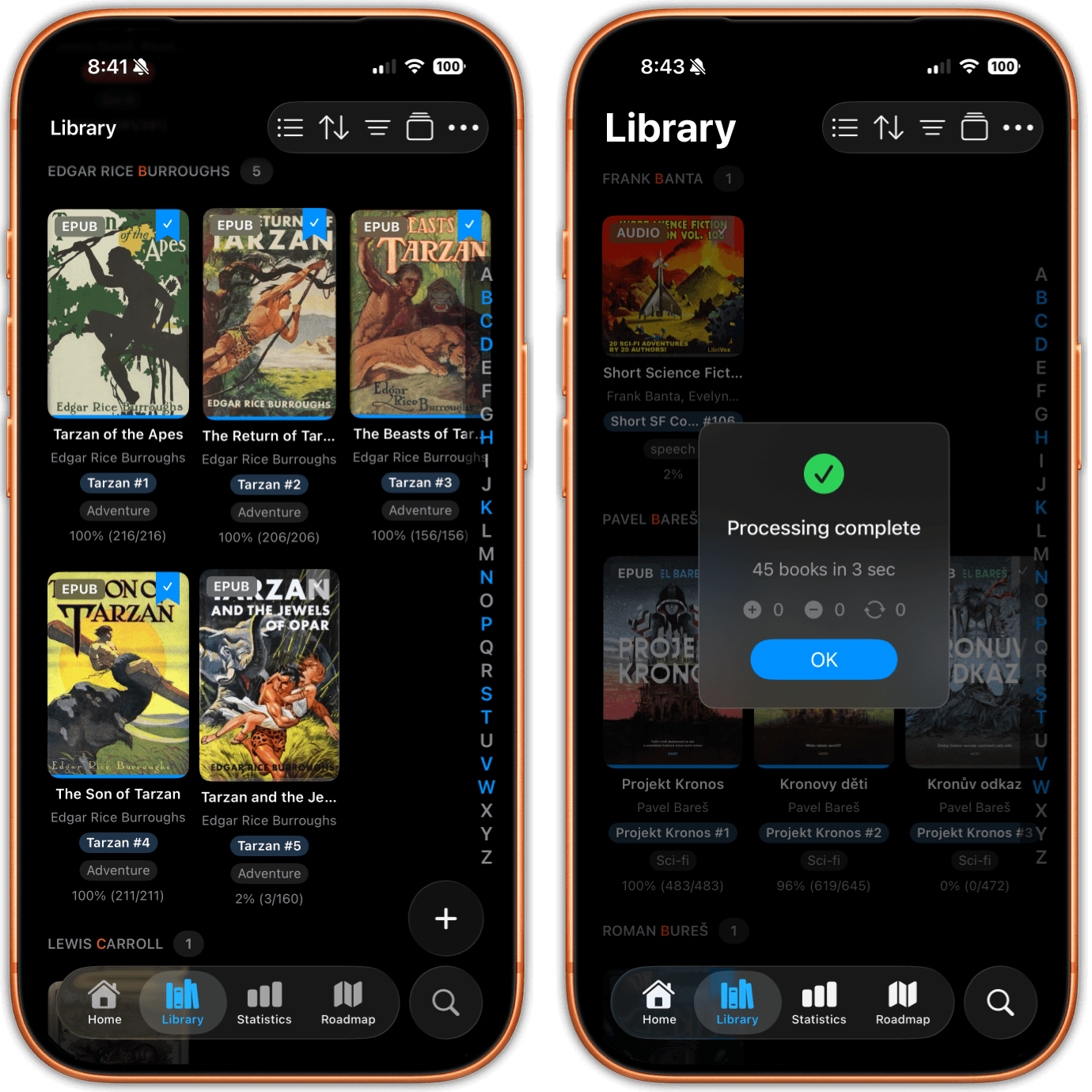
Point justRead at that folder. A lone m4b, mp3, m4a, aac or flac file arrives as one audiobook. So does a folder of chapter tracks, with the chapters in order. Title, author and cover art are lifted from the files, and every book in every subfolder is picked up, no matter how deeply it is buried.
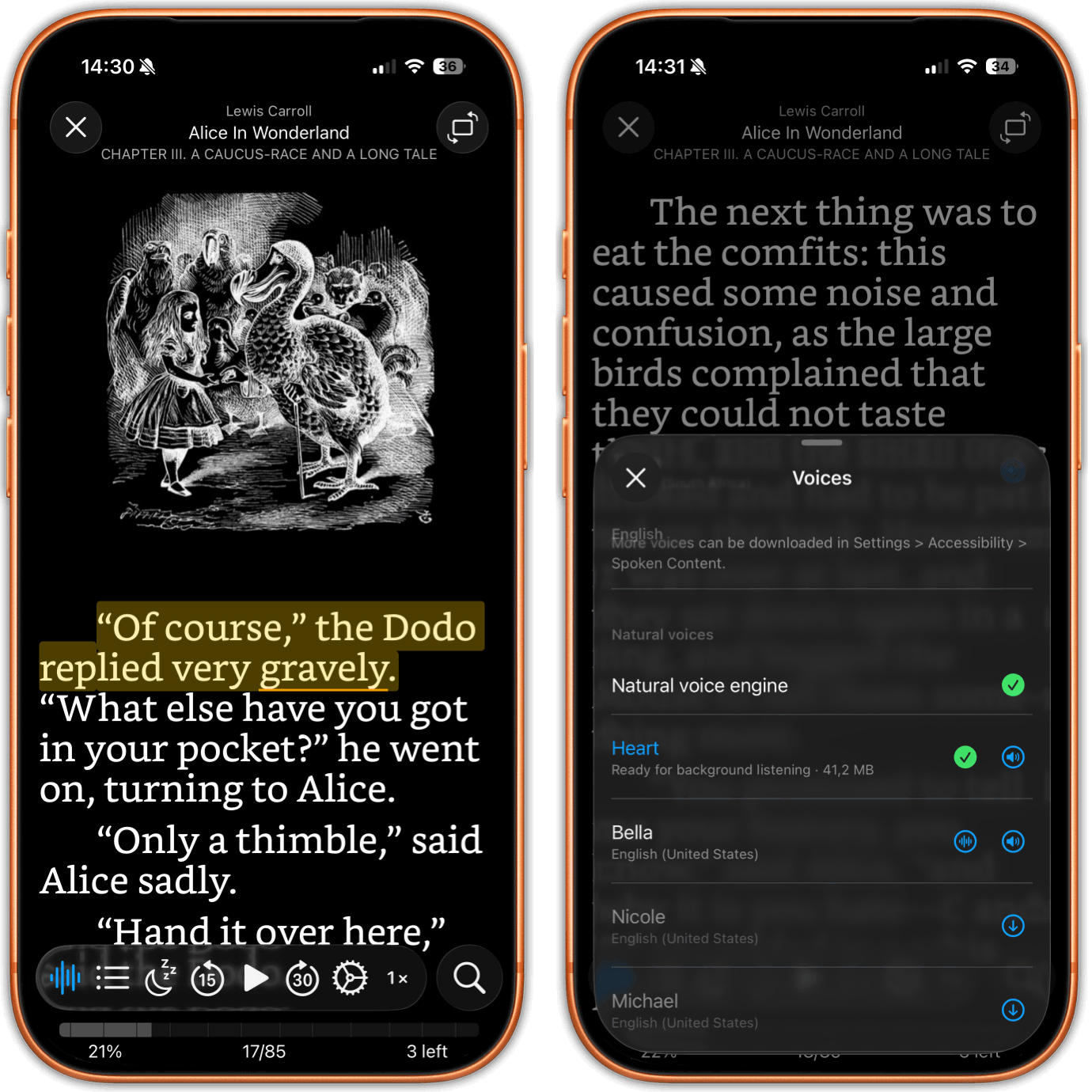
The chapter list tells you where you are. Speed runs between 0.75x and 2x, a single tap jumps thirty seconds forward or fifteen back, and the sleep timer halts the book once you nod off. Controls on the Lock Screen and in Control Center carry on working with the screen off.
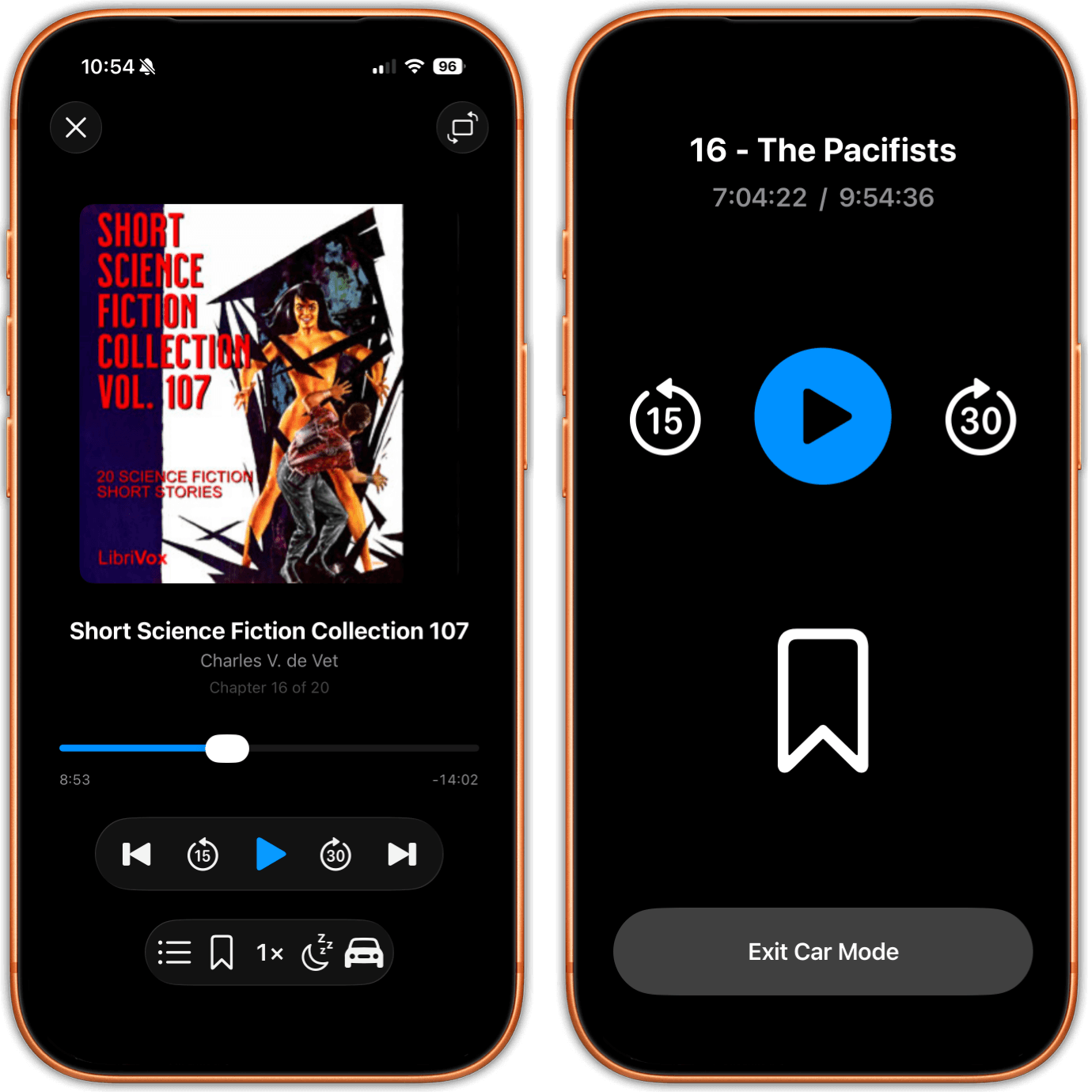
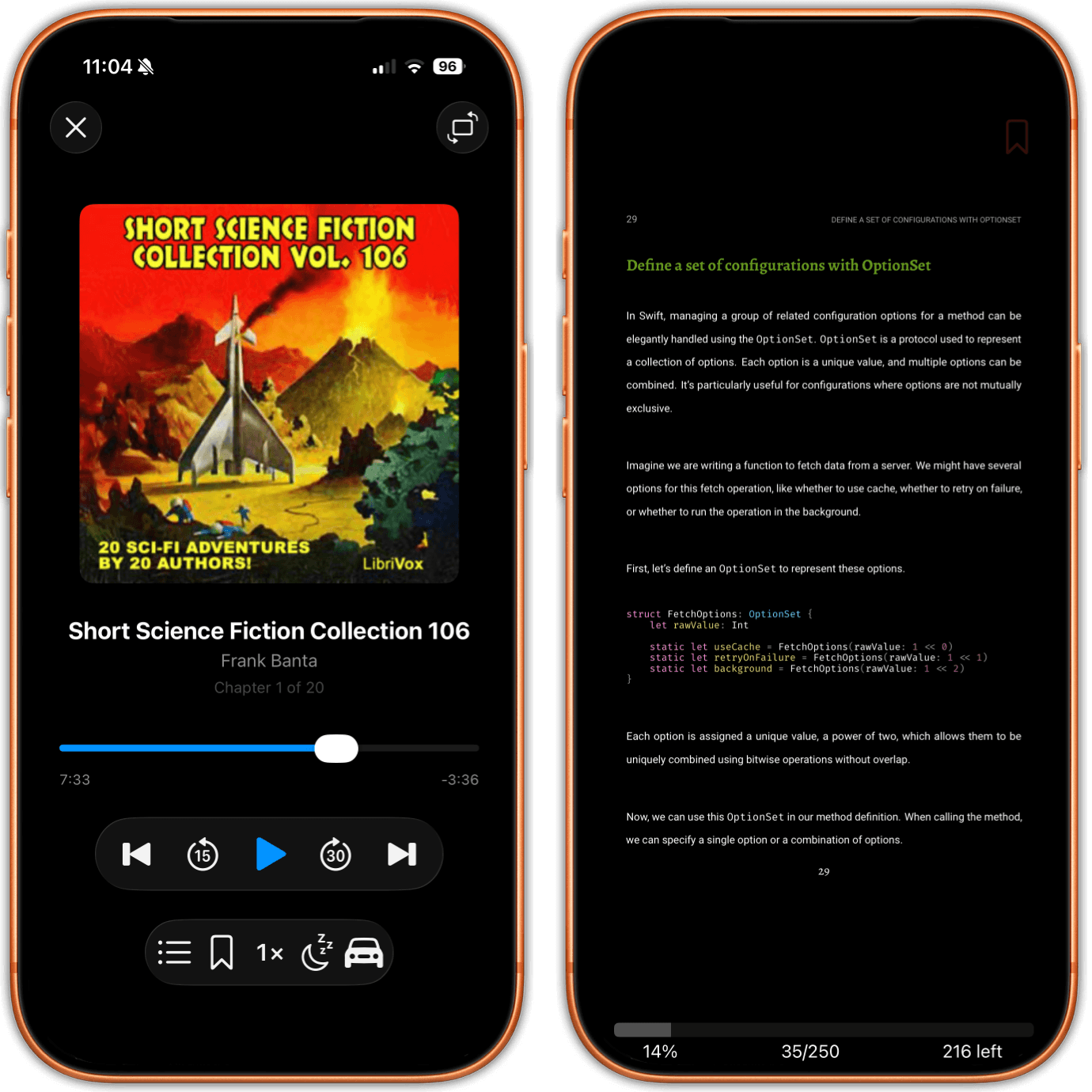
The player puts the cover, the author and your current chapter on screen, with a chapter list you can jump around inside. Speed runs between 0.75x and 2x, which covers the narrator who dawdles and the one who gallops. A single tap moves thirty seconds forward or fifteen back, and that is the granularity you genuinely want when a sentence slips by while you are parking. Bookmarks are held per audiobook, so a passage you want to find again is one tap away, and the sleep timer halts playback by itself.
Car Mode blows every control up to a size you can hit without looking, and a bookmark can be dropped from it while you drive. With the screen off, the Lock Screen and Control Center hold on to the transport controls, so the phone can stay in your pocket. To be precise about it: CarPlay is not here. Car Mode lives on the phone's own screen, not on the car's built in display.
An M4B is an MPEG-4 container, from the same family as an M4A or an MP4, carrying the same AAC audio. What marks it out as an audiobook rather than a song is metadata written inside the file: the container declares an audiobook media type, and the chapter marks sit in the file as a chapter track. That is how an M4B manages a genuine chapter list, and why a plain MP3 generally cannot.
justRead pulls that chapter information out of the file and presents it as a list you can jump around inside, with your current position marked. Title, author and cover art come from the same file on the same pass, so a properly tagged M4B lands in the library finished, with nothing left to type in.
There is no conversion step. Drop the m4b into a folder the Files app can reach and import it. Should your collection be a mixture of lone m4b files and folders of MP3 chapters, both shapes are handled, and each one ends up as a single book instead of a heap of tracks.
M4B sits in this page's title because it is what people search for, though the player is by no means limited to it. mp3, m4a, aac and flac all play, as do .audiobook and .zab packages. A .zab is nothing more than a ZIP archive holding a book's audio files, a format almost nothing on the iPhone will open, and justRead plays both package types like any other audiobook.
This is the commonest audiobook grumble on the iPhone, and it is hardly ever the player's doing. Three causes account for nearly all of it, and they are simple to tell apart once you know what to look for.
The first is a file that is not really an M4B. Renaming an .m4a to .m4b alters the name and nothing besides, and the bytes that declare the media type and carry the chapter track are not conjured up by renaming a file. The audio then plays perfectly well while the chapter list sits empty, because no chapter track was ever there to read. You will come across claims online that the two formats differ only in the extension. They belong to one container family, which is why the audio plays, but a renamed file with no chapter data has no chapters to show in any player, on any device.
The second is chapters written in a form the player is not looking at. Chapter marks in an MPEG-4 file may be stored as a QuickTime chapter track or as Nero style chapter atoms, and encoders write one, the other, or both. A file that produces a chapter list in one app and a single long track in another is usually this. So is the case people report where one book, after one sync, shows chapters on one device and none on the next.
The third is that it is an MP3, or a folder of them. MP3 has no container slot declaring a file to be a book, and while ID3 chapter frames do exist, most players pay them no attention. That is why a folder of chapter files is the sturdier shape for an MP3 audiobook, and why justRead builds the chapter list from the files in the folder instead of from tags nobody honours. To check a file before blaming any app, open it in a tool that will show you its container brand and its chapter list. A file called .m4b whose container brand reads as an audio file is the renamed case, and rebuilding it is the only proper fix.
A twenty eight track MP3 audiobook is not twenty eight books, and it has no business arriving in your library as twenty eight items. justRead imports a folder of chapter files as a single audiobook: one cover, one position, one entry in the library, and a chapter list assembled from the tracks inside it.
Two practical notes keep this tidy. Keep each book's tracks together in a folder of their own, one folder per book. And where track numbers form part of the file names, pad them with zeros, so that 02 sorts ahead of 10; poorly numbered tracks are the usual reason an audiobook plays out of order, in any app on any platform.
Nesting is no trouble. Point the app at a folder of audiobook folders, arranged by author or by series if that is how you keep them, and every book inside is imported however deep it is buried. Pull to refresh rescans and collects whatever you have added since. Delete a book inside the app and a later rescan will not haul it back.
The audiobook you had on during a walk and the PDF you are grinding through live in one library, inside one app, with one reading history behind the pair of them. No separate audiobook tab to remember, and no second subscription to pay for.
That matters more than it first appears. Own a book in two forms and the audiobook and the ebook become two entries to pick between depending on whether your hands are free, and both of them pour into one set of statistics rather than two that never meet.
Every cover carries a format badge, so an audiobook stands out at a glance among your EPUBs. Filter by format when audiobooks are all you want, and tap the same chip twice to leave them out instead. The app's own illustration of that exclude gesture is everything except audiobooks, which is precisely what you want while choosing something to read rather than listen to.
Title, author and cover art are lifted from the audio files during import, so a neatly tagged collection turns up looking right. Audiobooks then sort, group and search alongside everything else, and a filter combination you reach for often can be saved and recalled by name.
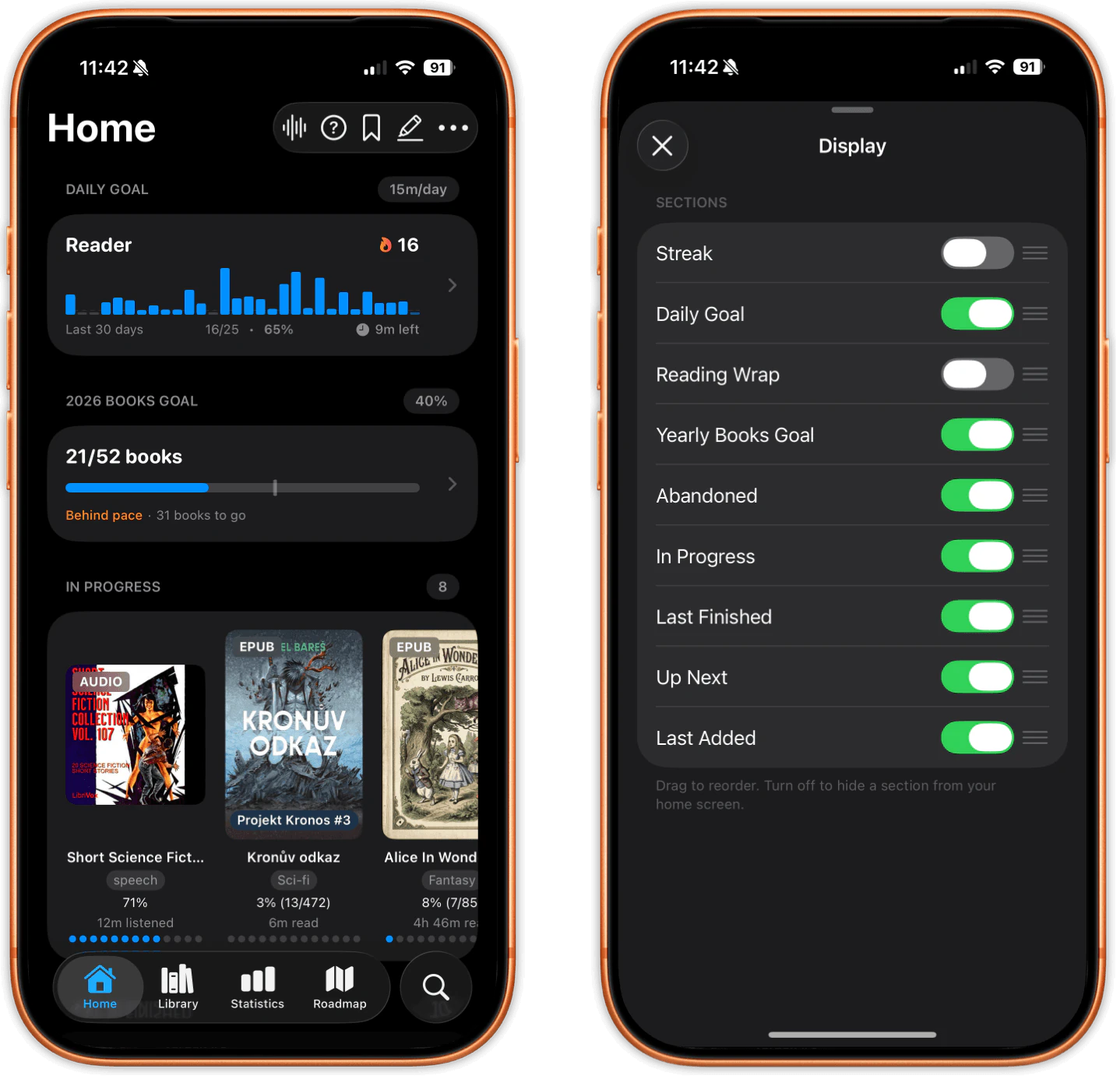
Minutes listened turn up on the Home shelf alongside minutes read. Listening pours into the same daily goal, the same streak and the same statistics as an EPUB, a PDF or a comic, because one app is keeping one count.
That is difficult to come by elsewhere, for a structural reason rather than a clever one: a dedicated audiobook app never sees the books you read with your eyes, and a dedicated reading tracker never hears the ones you listen to. Where half your reading is listening, the numbers finally admit it.
Two things get mixed up with the audiobook player constantly, so here is the distinction in plain terms. Read Aloud is speech synthesis. It reads an EPUB out loud in an Apple voice, or in a natural voice you download to the device, highlighting the sentence as it goes and turning the page on the word being spoken. EPUBs only: never a PDF, never a comic.
EPUB 3 read along narration is the third of the three. That is audio a publisher recorded and shipped inside the book itself, played back with the text highlighted in time with the voice, and it exists only for the handful of books that carry it. Neither is the audiobook player, which plays the m4b, mp3 and other audiobook files already in your possession and takes no interest in whether an ebook edition exists.
The gaps people genuinely hit when the file did not come from a shop
| What you are trying to get done | justRead.app | Apple Books on the iPhone |
|---|---|---|
| Importing an M4B on the phone itself | Straight out of the Files app | No import step on the device at all |
| A folder full of MP3 chapters | One book with one chapter list | Separate tracks, filed away as music |
| Moving the files onto the device | Any folder the Files app can reach, iCloud Drive included | Syncing from a computer, repeated for every addition |
| Where a book is allowed to come from | Any DRM free audiobook file in your possession | The Apple Books shop, or an import from a computer |
| Audio formats supported | m4b, mp3, m4a, aac, flac, .audiobook and .zab | M4B, while MP3s are routed off to Music |
| What else the same app will open | EPUB, PDF, plus CBZ and CBR comics | EPUB and PDF only |
Three differences that are structural rather than adjectival
Most audiobook apps are shopfronts. The player is the bit given away so that the books get bought from them.
justRead sells no audiobooks and keeps no catalogue. It plays the DRM free files you already own, from wherever you came by them.
Audiobooks over here, ebooks over there, and two sets of reading numbers that never meet.
Audiobooks, EPUBs, PDFs and comics share one library, one set of filters and one reading history, so listening counts towards the same streak.
The standard advice for loading audiobooks onto an iPhone still starts with plugging it into a Mac, and repeating that every time.
Import on the device from the Files app, folders that Dropbox, Google Drive or OneDrive sync in included. No cable, no conversion.
CarPlay is not here. What is here is Car Mode, a screen inside the app with oversized controls you can hit without looking, plus Lock Screen and Control Center controls while a book plays. Those are genuinely useful, and they are not the same thing as an app on your car's built in display. If CarPlay is why you are shopping, buy something else, and do it before the trial rather than after.
Audible is not supported. AA and AAX files are DRM protected and stay put inside Audible, and there is no route for importing an Audible library. Nor is there streaming from a server, so an Audiobookshelf or Plex collection wants a client built for that server. There is no shop, no catalogue and nothing to buy inside the app, and audiobooks are the one thing an OPDS catalogue will not hand you here.
Audiobooks carry no highlights or notes, and no metadata editing after import, so the title, author and cover art you end up with are the ones inside the files. And this is an iPhone and iPad app: no Mac, Android, Windows or web version exists.
See what readers are saying on the App Store
★ 4.6 / 5 · 24 App Store ratings
Fantastic eReader
Best app I've found for syncing with Calibre. Customisation rivals the great Marvin app, with superior library management.
Great app, responsive dev
The reading experience is already top notch. Really exciting to see where this app develops over time.
Excellent and complete
Beautifully designed and a pleasure to use. The developer had a clear plan from the very first version.
Excellent
Really well designed, and so pleasant to use.
Reading as you want it
A great new iOS epub reader with responsive developers actively adding features. Configure your reading experience just the way you like it.
The best reader on the App Store
Absolute control of customisation. Custom font support. The ability to vote on next features and development.
My new mobile happy place
A beautifully made reader app. Love the statistics and how it works with my 5,000+ book library and cloud storage.
Comprehensive epub reader for iOS
Finally an app that manages a book collection and acts as a fully functional reader. Streams from Dropbox without using phone storage.
The questions people genuinely ask before loading audiobooks of their own onto an iPhone
No. Audible's AA and AAX files are DRM protected, and that protection is the whole point of the format: only Audible's own apps can decrypt it. justRead plays DRM free files, so anything bought from Audible stays in Audible, and the same goes for anything borrowed or streamed rather than downloaded as an unprotected file. DRM free m4b or mp3 files that you own will play here.
Yes. It is one of the two shapes the player handles: a single file audiobook, or a folder of chapter files that becomes one audiobook with one cover, one position and one chapter list. There is no need to convert a folder of MP3s into an M4B first. Keep each book's tracks in a folder of their own and pad any track numbers in the file names with zeros, so that 02 sorts ahead of 10.
Three usual causes. The file may be an .m4a renamed to .m4b, which alters the name and not the bytes carrying the chapter track, so there are no chapters to read. The chapters may be written as Nero style atoms or as a QuickTime chapter track, and the app that wrote them and the app playing them may disagree about which to read; a book showing chapters on one device and not on another after the same sync is nearly always this. Or the file is an MP3, which has no container slot for chapters that players honour reliably. A folder of MP3 chapters sidesteps the problem altogether.
Yes. Listening pours into the same daily goal, the same streak and the same statistics as reading an EPUB, a PDF or a comic, and the Home screen shows minutes listened beside minutes read. One app keeps one count, which is how an audiobook on a long walk keeps a streak alive.
No. There is Car Mode, a screen inside the app with oversized controls sized for use at the wheel, setting a bookmark included, and there are Lock Screen and Control Center controls whenever a book is playing. Car Mode lives on the phone's own screen rather than on your car's built in display, so if CarPlay is a requirement, this is not the app for it.
Drop the files into any folder the Files app can reach and import them in the app. That covers folders on the device, iCloud Drive, and folders that Dropbox, Google Drive or OneDrive sync into Files. An audiobook can also be opened in justRead from a share sheet. Nothing needs plugging in, and nothing needs converting on a desktop first.
m4b, mp3, m4a, aac and flac, along with .audiobook and .zab packages. A single file becomes one audiobook, and so does a folder of chapter files. Title, author and cover art are read out of the files themselves, so a neatly tagged collection needs no tidying up afterwards.
A free 14-day trial with full access, no account required. After that it is £2.99/month or £17.90/year. The audiobook player comes as part of the app rather than an add-on, and a single purchase covers iPhone and iPad.