Success
The elephant in the room
You’ve probably felt it. That moment when you download an app that looks beautiful but feels wrong. The onboarding is confusing. Navigation is buried three taps deep. Performance stutters when you expect smoothness. The developer clearly built the app for themselves, not for you.
According to research, 68% of users will switch to a competitor after just one poor experience.
Another study found 88% of users abandon apps due to bad UX alone — not because they lack features, but because they feel poorly made.
What’s striking is that this isn’t accidental. It’s a symptom of how most apps are built: from the inside out. Developers ship features without asking if users actually want them. They guess at what “polish” means instead of asking or following guidelines. They update mysteriously, leaving users confused about what changed or why.
Most apps are made at users, not for them. And users notice.
The 15-year perspective
I’ve spent 15 years building software, and the last decade focusing obsessively on user experience. I’ve watched talented developers ship broken apps. Not technically broken — but broken in the ways that matter: confusing navigation, invisible affordances, missing the small details that make something feel intentional versus accidental — ever experienced misaligned icons?
And the worst part? Many developers don’t ask what’s broken and what the app needs. They release updates in silence. Users guess why something changed. Features land that nobody wanted. Features people asked for never ship.
Meanwhile, I’m also a lifetime reader. I’ve used every EPUB reader on iOS. I’ve felt the frustration — smooth scrolling that isn’t, fonts that don’t render properly, library management that feels like an afterthought, features that exist but feel bolted on.
It became clear: the apps that survive are built by people who deeply understand both craft and empathy.
Press enter or click to view image in full size

Developing justRead.app
The problem: apps without voices
Here’s what most apps do wrong: they assume users can read minds.
You download an app. It’s pretty. But then:
- You have an idea for a feature
- You email support (if there even is one)
- You never hear back
- Months later, a mysterious update arrives
- You have no idea if it addressed your feedback or ignored it
- You uninstall
- This happens because there’s no conversation. The developer is building in a vacuum. Users are waiting in the dark.
72% of users say they expect regular feature updates as extremely important or very important. But most apps provide zero visibility into what’s coming next. Not a roadmap. Not a hint. Just silence, then surprise.
This erodes trust. And once trust is gone, so are you.
The better way: an in-app roadmap where users vote
This is where justRead is different.
Right in the app, you’ll find the Feature Roadmap — a living, breathing board where you can:
- Vote on features you want to see built next
- See exactly what’s in progress (because transparency matters)
- Track completed features and know your voice shaped them
- Comment and discuss ideas before they’re implemented
- Understand the “why” behind development decisions
- This isn’t performative transparency. It’s not a gesture. It’s the actual mechanism by which justRead is built — using VoteFirst, a platform designed specifically for this purpose. Your votes influence what gets built. Your feedback shapes how it gets built. The roadmap updates live — you see progress in real time.
Why does this matter?
When users can see and influence the roadmap, something shifts: they go from being customers to being partners. Research shows users who participate in voting are significantly more likely to appreciate updates when they ship — not because the features are better, but because they see themselves in the product.
They feel heard. And when users feel heard, they stay.

Screenshot showing actual state of justRead in-app roadmap with voting.
Proof that polish matters
I didn’t enter indie app development to build a mediocre reading app. I built justRead because I wanted to create something that feels intentional in every interaction.
That means:
- Smooth scrolling that doesn’t stutter
- Thoughtful font rendering that respects typography
- Micro-interactions that feel responsive, not delayed
- Consistent design language throughout (not features that feel bolted on)
- Performance optimization so the app doesn’t drain your battery
- Respecting Apple design guidelines
- This is tedious work. No user notices these things consciously. But they feel them. An app that’s been polished feels different — lighter, faster, more trustworthy. An app that hasn’t feels like extra work.
This isn’t vanity. Research shows that app performance and stability directly impact how users perceive your entire brand. One laggy app, and users assume you’re careless everywhere. One smooth app, and they assume you care about details that matter.
The message to users
If you’re a reader considering justRead, here’s what we’re offering: an app built by someone who reads, who understands what makes apps feel good, and who believes you should have a voice in what gets built.
You’re not downloading software. You’re joining a community where your vote matters and your feedback shapes what comes next. Features land because you asked for them, not because a product manager guessed.
That’s a different kind of relationship. One where the developer is visibly, consistently working for you.
Join the waitlist at justread.app and be part of this process. See the roadmap for yourself. Vote on features. Help us prove that apps can be built for readers, not at them.
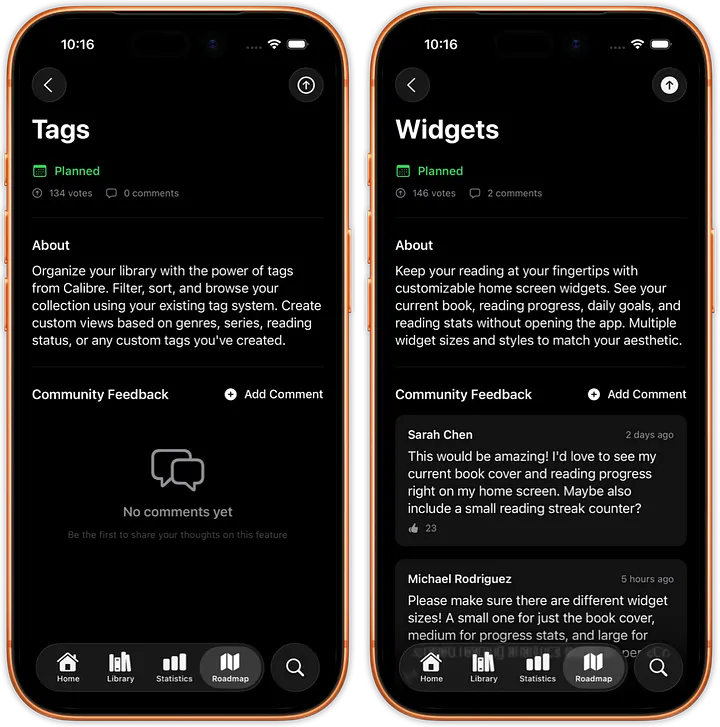
Screenshot showing actual state of justRead in-app roadmap with commenting.
The message to developers
If you’re a developer reading this, consider what justRead is doing: creating an in-app feature roadmap with user voting.
Why is this a differentiator? Because most apps don’t do it. Most developers hide their roadmap (if they have one). Most users have no idea what’s being built or if their feedback matters.
But users crave this transparency. It’s low-cost to build — a GitHub Project, a Notion board, or a dedicated platform like Frill, Changelogfy, or VoteFirst. The hard part isn’t the tool. It’s the commitment: showing your users you’re willing to be transparent about progress, priorities, and constraints.
When users see your roadmap, they understand:
- What you’re working on right now
- What’s coming next (and when)
- Why some features get prioritized over others
- That you’re actively listening
- This builds trust in ways that polished marketing can’t touch.
It’s also a recruiting tool. Developers and designers are attracted to projects that care about users. Transparency says: “We’re not hiding anything. Come build with us.”
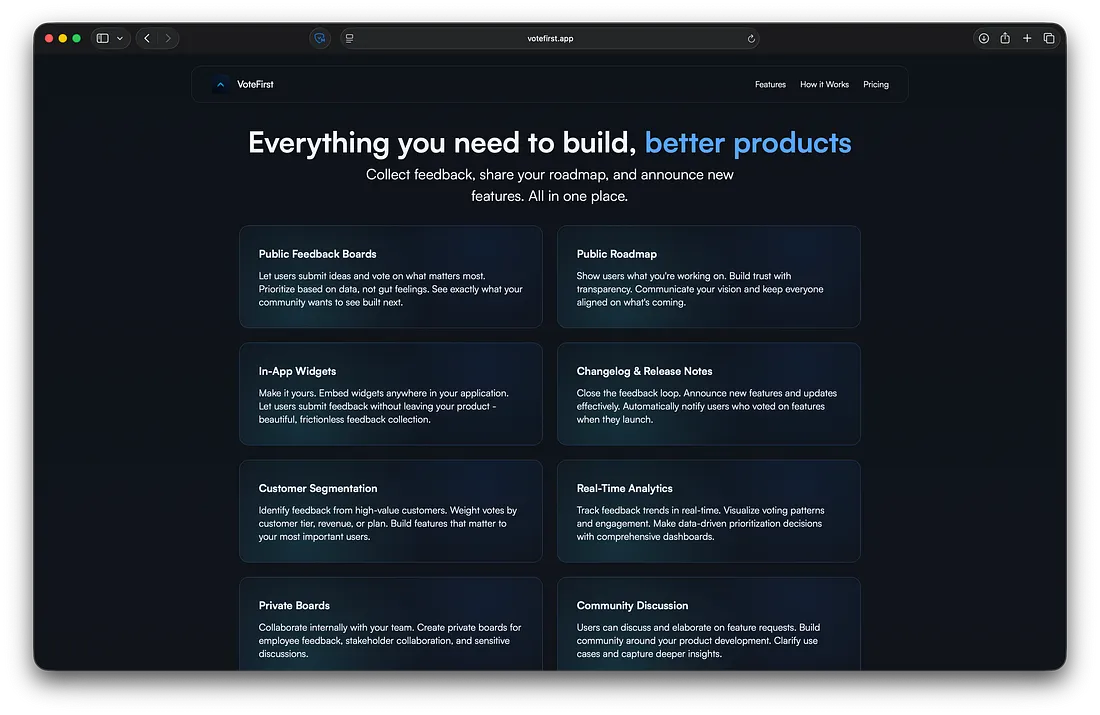
justRead is powered by voteFirst.app
The unspoken competition
The competition for user attention isn’t just between EPUB readers. It’s between apps that feel like they want to work for you and apps that feel like they’re tolerating your existence.
Most apps fall into the latter category. They’re technically functional but emotionally cold. No voice. No relationship. No sense that a human being made thoughtful choices about every detail.
The apps that win — and I mean truly win, with loyal users who evangelize them — are the ones that feel personal. That feel like someone cared enough to polish every interaction. That feel like the developer is sitting across from you, listening to what you need.
That’s not a coincidence. That’s design.
What’s next
justRead launches with a public, in-app roadmap where you can see every feature in progress and vote on what comes next. This isn’t a “maybe someday” feature. It’s core to how we build.
If you’re a reader, that means your voice matters from day one.
If you’re a developer, consider: What if your users didn’t have to wonder what you’re building? What if they could see, vote, and feel ownership over your product’s direction?
The difference between an app that works and an app that matters is smaller than you think. It starts with listening. It continues with transparency. And it compounds when users feel like partners instead of customers.
Most apps miss this. They release in silence. They update mysteriously. They hope users stay.
justRead is built differently.
Your vote. Your voice. Your app.
Ready to join?
If you want to be part of shaping justRead’s future — and you’ve been waiting to see what makes this app different — your moment is coming.
→ Join the waitlist at justread.app
Watch the roadmap. Vote on features. See your feedback become reality. Help us prove that apps can be built forreaders, not at them.
P.S. If you’re a developer interested in implementing feature voting in your own app, check out VoteFirst — that’s what powers justRead’s roadmap. Transparency and user collaboration should be standard practice, not an afterthought.
Peter
Reader, Developer, justRead Creator